Sales prospecting has fundamentally changed. The days of manually scrolling through LinkedIn, copying emails into spreadsheets, and sending generic cold outreach are over. In 2026, the best AI tools for sales prospecting combine high-quality B2B data, real-time intent signals, and automated personalisation to help sales teams find the right prospects, at exactly the right moment, with exactly the right message. For start-ups and scaling businesses in the UAE and beyond, adopting this technology is no longer optional, it is the defining difference between a pipeline that stalls and one that grows consistently.
Key takeaways
AI prospecting tools do four core jobs: lead identification and scoring, data enrichment, personalised outreach generation, and workflow automation.
No single tool wins every use case. The best choice depends on your channel focus (email, LinkedIn, or web), your existing CRM, and your team's technical capability.
Intent signals are the competitive edge. Platforms like 6sense and ZoomInfo surface accounts actively researching solutions, giving sales teams a critical timing advantage.
CRM-embedded AI agents (Salesforce Agentforce, HubSpot Breeze) deliver the highest ROI for organisations that already hold large historical sales datasets.
Implementation quality matters more than tool brand. According to IBM and Outreach, the effectiveness of any AI prospecting stack depends primarily on how well the tool is configured against your ideal customer profile (ICP).
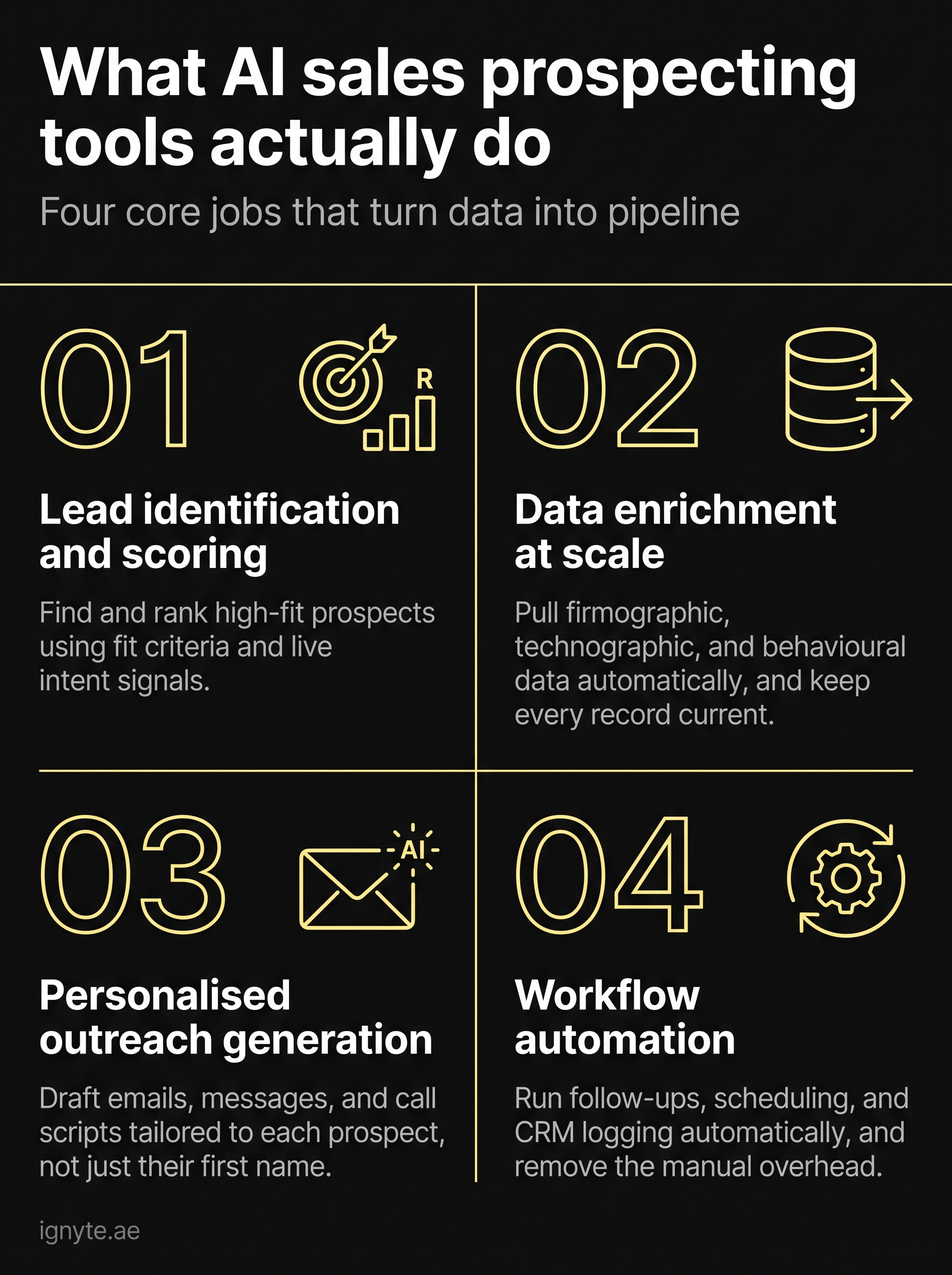
Lead identification and scoring: Machine learning and predictive analytics find and prioritise high-value prospects based on fit criteria and live intent signals.
Data enrichment at scale: Platforms automatically pull firmographic, technographic, and behavioural data from multiple sources to build and continuously update prospect records.
Personalised outreach generation: Generative AI and natural language processing (NLP) craft emails, social messages, and call scripts tailored to each prospect's specific needs and behaviour patterns.
Workflow automation: Follow-ups, meeting scheduling, CRM logging, and multi-step outbound sequences run automatically, reducing manual effort and accelerating response time.
These tools analyse website activity, email engagement, content consumption, and intent signals to determine when a prospect is most likely to buy, then trigger timely, contextually relevant outreach automatically.
The four categories of AI prospecting tools
1. Data and intent platforms: finding who to contact
Data and intent platforms solve the fundamental question every sales team faces: who should we actually be talking to right now? These tools focus on contact data, account intelligence, and buying intent signals to surface the highest-priority prospects from your total addressable market (TAM).
ZoomInfo: A go-to-market (GTM) intelligence platform that provides deep company and contact data alongside buyer intent signals and predictive analytics. Its AI surfaces accounts showing early buying behaviour and aligns outreach timing to prospect activity.
Apollo: Combines contact data, account intelligence, and outbound execution in a single platform. AI identifies target accounts, enriches lead data, and prioritises outreach based on engagement signals, making it a strong all-in-one option for growth-stage start-ups.
Cognism: A global B2B prospecting platform built around GDPR (General Data Protection Regulation)-compliant data and phone-verified mobile numbers. Its AI-driven intent signals and enrichment features make it particularly valuable for international and regulated markets.
6sense: Uses predictive analytics and intent data to identify accounts actively researching solutions in your category. It is particularly strong for account-based marketing (ABM) and enterprise sales motions where deal cycles are long and stakeholder groups are complex.
Seamless.ai: AI-powered contact discovery and real-time verification, integrated directly with LinkedIn and browser environments.
LeadIQ: Designed for LinkedIn-first workflows. LeadIQ captures prospect data, tracks job changes, and enriches contact records, ideal for teams whose prospecting starts on LinkedIn.
2. Outbound and multichannel automation platforms: executing outreach
Once you know who to contact, outbound automation platforms handle the execution. These tools combine list building, AI personalisation, deliverability optimisation, and follow-up automation. As Clay's practical guide to using AI workflows for B2B sales prospecting demonstrates, connecting multiple enrichment sources through AI-powered workflows produces significantly higher reply rates than traditional bulk outreach.
Clay: Connects multiple data sources and applies AI to enrich, score, and segment leads dynamically. Widely used for highly personalised outbound campaigns and technically advanced prospecting workflows. Favoured by growth teams comfortable with API-based configurations.
Instantly: An outbound-focused platform combining prospecting, personalisation at scale, and follow-up automation, well suited to high-volume cold email campaigns.
CoPilot AI: A LinkedIn-focused AI prospecting platform for finding high-intent leads, automating outreach sequences, and booking meetings directly within LinkedIn. Practitioners consistently highlight its ability to remove the "grunt work" of finding and messaging prospects.
Qualified: An AI-powered inbound pipeline generation platform that autonomously engages website visitors in real time to capture and convert leads, a strong fit for SaaS companies with meaningful organic web traffic.
HubSpot Breeze Prospecting Agent: A specialised AI assistant that pulls prospect information from the web, auto-enrols leads into CRM, and drafts personalised outreach campaigns at scale, ideal for teams already running on HubSpot.
Highspot: A unified GTM (go-to-market) platform featuring an AI and analytics engine with customisable AI sales agents and role-play coaching. It helps sales reps deliver highly relevant content and messaging to high-value prospects at the right stage of the buying journey.
3. CRM-embedded AI agents: prospecting inside your existing stack
The major CRM vendors now embed prospecting agents directly into their platforms, which means organisations with large historical datasets unlock compounding advantages as the AI learns from existing wins, losses, and activity patterns.
Salesforce Agentforce Prospecting Agent: An always-on AI agent that uses lead and contact records, call recordings, emails, and third-party sources to autonomously engage inbound prospects. It researches accounts and contacts, ranks them against your ICP, surfaces the best prospects directly in CRM, answers product questions, handles objections, and books meetings. As the Salesforce guide to AI-powered sales prospecting and prospecting agents outlines, this frees sales reps to focus exclusively on closing.
Microsoft Copilot (for Outlook, Teams, and Dynamics 365): Compiles meeting summaries, agendas, and follow-up suggestions across sales workflows, acting as a digital assistant that reduces administrative overhead so sellers focus on relationships.
4. Specialist tools and emerging patterns
The Forbes analysis of leading AI tools for CRM, sales, and prospecting identifies 19 tools that supercharge pipeline generation, with a consistent emphasis on tools that bring enriched lead data directly into CRM for immediate follow-up. Among practitioners in growth hacking communities, Clay, Crustdata, and Sapiengraph appear frequently for real-time LinkedIn data and Google Sheets-based lead discovery workflows. Separately, independent benchmarking of general-purpose AI models, including ChatGPT, Claude, Gemini, and Grok, across B2B prospecting tasks such as research, cold email writing, and call scripting places Claude at the top across multiple use cases.
How to implement AI prospecting tools effectively
Tool selection accounts for a fraction of the outcome. IBM and Outreach both assert that the effectiveness of any AI prospecting stack depends primarily on implementation quality, not the brand on the platform. Here is how high-performing sales teams structure their AI prospecting systems:
Define and refine your ICP first: Use AI to analyse your best existing customers and uncover non-obvious common traits: technology stack, headcount growth patterns, LinkedIn posting frequency, funding stage. A precise ICP is the single most important input to any AI prospecting system.
Configure lead scoring around fit and intent: Build scoring models that weigh both firmographic fit (industry, size, geography) and behavioural intent (pricing page visits, content downloads, email engagement). Tools analyse these engagement metrics and rank leads by likelihood to convert, but only if the scoring logic is properly configured.
Set intent-based outreach triggers: Configure AI systems to monitor website visits, pricing page views, and content downloads, then fire real-time alerts when prospects demonstrate high intent. Timing outreach to intent signals consistently outperforms calendar-based sequences.
Build hyper-personalised campaigns, not templates: Use generative AI to tailor email and social outreach to each prospect's specific pain points, interests, and stage in the buying journey. Generic personalisation tokens ("Hi [First Name], I saw you work at [Company]") no longer produce meaningful reply rates.
Automate pipeline hygiene and follow-up: AI summarises calls, identifies action items, drafts follow-up emails, and keeps CRM records current. Sales managers gain accurate pipeline visibility without chasing reps for manual updates.
How to choose the right AI prospecting tool for your business
Every sales team faces a different bottleneck. Selecting the right tool means diagnosing your specific constraint first, then matching the tool to that constraint. The Highspot guide to the best AI sales tools and synthesised guidance from Salesforce, IBM, Outreach, and industry practitioners point to five key selection criteria:
Data coverage and compliance: For global outreach or markets with data protection regulations, prioritise tools like Cognism with a strong compliance posture and verified contact data.
Depth of intent signals and predictive scoring: Teams running ABM or enterprise sales motions extract the most value from tools like 6sense or ZoomInfo, which provide robust intent data and predictive models capable of identifying in-market accounts weeks before competitors.
Integration with your existing CRM and tech stack: Salesforce users benefit most from Agentforce. HubSpot users benefit most from Breeze. Forcing a standalone tool to sync with an incompatible CRM creates data quality problems that erode ROI quickly.
Channel focus: For email-heavy outbound, Clay and Instantly deliver the strongest results. For LinkedIn-heavy outbound, LeadIQ, CoPilot AI, and Seamless.ai lead the category. For inbound web engagement, Qualified operates autonomously without requiring manual rep intervention.
Team skill and workflow fit: Highly technical teams exploit Clay's flexible API-friendly architecture and custom enrichment workflows. Less technical SMB teams achieve faster time-to-value with all-in-one suites like Apollo or ZoomInfo, which require less configuration to produce results.
Frequently asked questions
What is the best AI tool for B2B sales prospecting in 2026?
There is no single best AI tool for B2B sales prospecting: the optimal choice depends on your team's size, technical capability, primary outreach channel, and existing CRM. Apollo delivers the strongest all-in-one value for start-ups and SMBs. ZoomInfo and 6sense lead for enterprise and ABM motions. Clay is the top choice for technically advanced teams running hyper-personalised outbound campaigns. Salesforce Agentforce and HubSpot Breeze deliver the best results for teams already deeply invested in those CRM ecosystems.
How do AI prospecting tools use intent data to improve sales outcomes?
Intent data tracks digital behaviour signals, including website visits, pricing page views, content downloads, review site activity, and search behaviour, to identify accounts actively researching solutions in your category. AI prospecting tools ingest these signals in real time, score accounts by purchase likelihood, and trigger outreach at the precise moment a prospect shows buying intent. Platforms like 6sense and ZoomInfo surface accounts weeks before they formally enter a sales process, giving sales teams a material timing advantage over competitors who rely solely on static contact lists.
What should a UAE start-up consider when selecting an AI prospecting tool?
UAE start-ups prospecting globally need to prioritise data compliance, particularly GDPR compliance for European prospects. Cognism stands out for its phone-verified mobile data and compliance-first architecture. For start-ups focused on regional B2B markets within the UAE and GCC, Apollo provides strong Middle East contact coverage with accessible pricing for early-stage teams. Start-ups scaling with limited sales headcount benefit most from tools like CoPilot AI or Clay, which automate the volume and personalisation tasks that would otherwise require multiple full-time sales development representatives (SDRs).
Accelerate your B2B growth with expert guidance
Selecting and implementing the right AI prospecting stack is a strategic decision, and the technical landscape evolves faster than any single team tracks alone. The configuration choices you make in your first 90 days shape your pipeline quality for years. To implement these tools with precision and avoid the costly trial-and-error phase that slows most start-ups down, connect with Ignyte's network of seasoned sales and growth mentors, practitioners who have built high-performance B2B prospecting systems across the UAE and international markets, and who accelerate your path from tool selection to measurable pipeline results.
Subscribe to our newsletter
Subscribe to our newsletter to stay updated with the latest news, offers, and insights!